
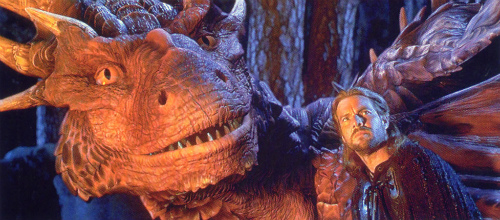
 Rob Cohen’s “Dragonheart” is a film that was admittedly a favorite of mine when I was growing up. When it first premiered on cable, I recorded it on VHS and would watch the movie at least five times a week. Years later, “Dragonheart” is still a fun and rollicking bit of family fantasy fare. It’s by no means a masterpiece, but if you’re in the mood for a nice and breezy fantasy adventure with a hint of menace to it, you might enjoy what Cohen brings to the table. This is also one of the very few buddy action movies involving a human and a dragon, both of whom make up a bickering pair of friends that find common ground and a common enemy.
Hag (2014)
 “Old Hag Syndrome” is a state of paralysis where the sleeper usually awakens completely frozen, but conscious and is convinced a supernatural entity is among them and is sitting on their chest. This is where the origin of creatures like the Succubus stems from. Scott Somers is a seemingly normal man married to a beautiful wife named Marie, but every night he awakens to see his wife standing at the window and muttering to herself. Convinced she’s sleepwalking, Scott awakens yet again in the middle of the night, but this time incapable of movement.
GiverTaker (2016)
 For the nineties kids that grew up with great YA horror fodder like “Goosebumps,” “Fear Street,” and “Are You Afraid of the Dark,” director Paul Gandersman and writer Peter S. Hall really seem to have done their research, building a pretty damn great short horror film around the mold of a series called “The Dead Kids Club.” I hope they can find the funding to continue producing films under this label, as I’d love to see a series of shorts or feature length films within “The Dead Kids Club” concept.
Jack Goes Home (2016)
 Father to be Jack learns that his father has been killed in a gruesome car accident and he travels home to go take care of things and help his mother get better. Once home, he discovers long buried secrets about his family and himself. Written and directed by actor Thomas Dekker, the film centers around the character of Jack as he comes to grip with his father’s passing and his past as he discovers bits and pieces of it while working on getting his mother back into shape. The character of Jack is nicely complex and he is a good representation of what a man may go through when losing his father. This is of course not as simple as it seems, especially given that it is considered drama, thriller, and horror. The film develops themes that fit all three of those categories and themes that connect with audiences.
Boy Eats Girl (2005)
 “Boy Eats Girl” derives many elements from “Shaun of the Dead” as a romance comedy with a horror and zombie twist, all the while adhering to a lot of the classic teen romance tropes. There’s the alpha female, and geeky best friends, while our hero is a reluctant protagonist thrust in to an extraordinary situation that rekindles his love for his girlfriend. Nathan is a student at a local school where he constantly fawns for the love of his life Jessica who may or may not have the same feelings. After a misunderstanding, Nathan gets drunk, and accidentally hangs himself. His mom brings him back from the grave (When are people going to learn not to use mysterious books to do magic?), and all seems too good to be true.
Repossessed (1990)
 I guess if you’re going to try to spoof a hit horror movie, you might as well bring with you the star of said film. For better and for worse, Linda Blair is now and will always be associated with her star making turn as Regan in “The Exorcist.” Sadly, she’s more known for the movie, than being a strong actress who gave a strong and compelling performance. Blair uses the chance starring in “Repossessed” to burn the whole motherfucking kit and caboodle to the ground hamming it up big time in a role that’s basically Regan 2.0 if Regan became a doting housewife revisited by Pazuzu. This time, though, she’s named Nancy. Get it? Nancy Regan?
Exorcist II: The Heretic (1977)
 In 1977, James Earl Jones co-starred in what is arguably one of the greatest movies ever made, and what is arguably one of the worst movies ever made. “Exorcist II: The Heretic” is a fine example of what could have happened if the original “The Exorcist” ended as an ill-conceived pseudo-spiritual mess. A bad idea from beginning to end, it’s one of the iconic bad sequels that is famously recollected by its producers as the movie that literally got them chased out of a theater by angry movie goers. Four years after being victimized by a demon, Regan MacNeil has somehow managed to put her life back together and live some semblance of normality. Sadly after the demonic possession, everyone’s life was just about ruined, and Regan’s life remained basically the same, as her mother Chris is frequently out of town. Does a girl have to get possessed again to get your attention, Chris?