
 NOW SEEKING FUNDING ON KICKSTARTER – Jason Turner’s “Sentinel” reminds me a lot of the Harry Canyon segment from “Heavy Metal” except so much more of a neo-noir cyberpunk love letter than the former. Presented as a motion comic, Jason Turner plays Ex-Cop Alex Calibourne, a man with enhanced body augmentations that lives in a crime ridden albeit futuristic city named Iron City. Calibourne lives and breathes by his robotic enhancements, and uses his artificial intelligence J.E.S.S., a sassy female AI, to guide him through his adventures in the underworld.
Tag Archives: Thriller
Slasher: Season One [Blu-Ray]
 When last we saw Katie McGrath, she was suffering a cruel and unnecessary death in “Jurassic World,” and has now entered the sub-genre of the slasher film. A skosh more entertaining and engrossing than “Scream,” Chiller TV’s “Slasher” is a very entertaining, and tense slasher film that mixes in elements of a murder mystery in the process. I had no expectations for “Slasher,” and surely enough it won me over after two episodes, working within the confines of the slasher sub-genre, while also side stepping some of the more common clichés here and there. Much like “Scream,” main character Sarah comes from a small town where everyone has skeletons in their closets.

Specter of the Rose (1946)
In 1946, low-rent Republic Studios lured Oscar-winning writer Ben Hecht with the offer of being able to produce and direct films. But while the studio gave Hecht creative liberty, it imprisoned him within its ridiculously low budget framework. For his first (and, it turned out, only) Republic offering, Hecht had $200,000 to spend.
The resulting work, “Specter of the Rose,” turned out to be one of the most bewildering features of Hollywood’s Golden Age. Part-thriller, part-light comedy and part-ballet, the production was an emotionally bipolar experience. It also betrayed Hecht’s limitations as a filmmaker – cinematographer Lee Garmes shared co-director status, albeit with minimal prominence in the credits.
“Specter of the Rose” focused on the efforts of would-be impresario Max Poliakoff (played by Russian acting teacher and occasional thespian Michael Chekov) trying to pull together various dubious talents for a major ballet endeavor. Aging ex-ballerina Madame La Sylph (Judith Anderson) reluctantly agrees to get pulled into Poliakoff’s scheme, which involve bringing the elusive ballet star Andre Sanine (Ivan Kirov) back to the stage. Sanine had been sidelined following the on-stage death of his wife, and in his grief he began proclaiming that he was responsible for her death. But the offer to star and choreograph a new production, coupled with his sudden infatuation for Haidi, one of Madame La Sylph’s students (Viola Essen), brings Sanine back to performing.
However, the endeavor is wrought with endless problems: Poliakoff runs up debts and resorts to outrageous lies to keep his creditors pacified while a degenerate poet (Lionel Stander) whose love for Haidi goes unrequited stalks the ballerina. Haida winds up marrying Sanine, but his mental health begins to fray after their wedding – and it appears that his distraught claims about being responsible for his wife’s death had a ring of truth.
“Specter of the Rose” is notable for carrying some of the most pretentiously peculiar dialogue in the history of English-language cinema. Lines such as “The lunacy of great artists usually produces masterpieces, not murders” and “The suffering of the masses is a minor phenomenon beside one man’s tears” and “Hug me with your eyes” crash throughout the story, and it is hard to determine whether Hecht was trying to make an artistic statement or if he wrote the script while drunk.
There is also the bizarre performance by Chekov – with his wavy hair, oversized boutonnière and florid use of language (everyone is called “darling,” regardless of gender), his Poliakoff vividly shredded the Production Code’s taboo on obvious homosexual characters. The character’s atrocious behavior – deliberate mistruths, unctuous flattery and silly threats – makes him maddening rather than amusing. Matching Chekov for sheer strangeness is Stander, the gravel-voiced character actor whose line readings of Hecht’s overripe dialogue are so tortured that it feels like he is reciting his part phonetically.
And as for the grand ballet that is promised for the first two-thirds of the film, the resulting production is such a Republic-caliber cheapjack offering that it feels like the screenplay’s endless teasing of a masterwork was the ultimate bait-and-switch – especially since the title and a few dialogue references to the ballet “Le Spectre de la Rose” seem to suggest there would be a version of that masterwork on screen.
Nonetheless, “Specter of the Rose” keeps the viewer attention through Garmes’ effective noir-style cinematography (which mostly hides the poverty of the budget) and a stunning performance by Ivanov, a Broadway chorus dancer making his film debut. His rugged physical presence and offbeat interpretation of the increasingly unhinged ballet star dominates the film – and even if Tamara Geva’s choreography is less than stellar, Kirov’s physicality and emotional interpretation of the work saves the day. (Sadly, this was his only film appearance.)
And for all of its failings and weirdness, “Specter of the Rose” ties up brilliantly for its startling climax, where Sanine’s madness and sense of artistry duel over him. Without giving too much away, it can be said that this sequence embodies an astonishing mix of Garmes’ visual style, Kirov’s magnificent dramatic and physical talent and Hecht’s audacity to ratchet up the bizarre to a level of intellectual horror. This leaves the viewer with a sense of “what the hell was that?” – but, also, a subsequent consideration of “wow, that was really different!”

Bachelor Games (2016)
 Henry is about to marry the love of his life, so he and the guys go to Argentina for an epic bachelor party/trip. Once there, there’s booze, strippers, and drugs before a sobering hike in the mountains where they meet a mystical figure called The Hunter and things get bloody.
The film is written by Chris Hill and Sam Michell who created a believable group of friends with problems and normal lives. None of the five leads are perfect; they all have issues, giving them humanity when they could have easily been caricatures like in The Hangover series. These guys are close, or used to be, and it shows through their interactions. Of course, not all the situations they are put in are realistic given the Hunter figure but having built a believable setting with human characters, the mystical or paranormal works as well.
This script is brought to the screen by Edward McGown a mostly non-fiction director. His nature documentary eye shows in how he shoots the mountains in which the five men go on a hike. Here he crafts a movie that looks beautiful and is suspenseful once the creepy figure of the Hunter shows up. He also brings his actors together in a way that works, whether they are having fun or fighting.
The cast of Bachelor Games is good with a couple of very strong performances. Jack Gordon as the groom to be, Henry, brings many layers to his character that starts off happy and then shows conflict and worry. His character has possibly the most to lose and the most to learn in the bad situation they find themselves in. As Henry’s best man/friend Leon, Charlie Bewley brings layers of slightly off, slightly creepy, womanizing, party boy with no regrets over anything he’s done. That is until he starts fearing for his life and reconsidering what is important in life. Both of their characters have interesting arcs and their performances go with that.
The rest of the cast does well too, Jake Doolan does a convincing drug-addicted bro as Terrence, Mike Noble shows sensitivity as Roy, and Obi Abili brings us an attempting-to-be happy army man with potential PTSD. However, viewers should not be fooled by these performances as almost nothing is as it appears here. The film works as a drama and as a mystery/thriller, it even works as a horror film as it has a lot of elements of the genre in it. The Hunter figure is creepy and adds a chilling element while its design is beautiful. The film has some blood but no real gore to speak of. The blood looks really good and real, even in bright light. They do not shy away from it or hide it in darkness, the violence leads to blood as it should and is clearly shown.
Also worth noting for this film is the cinematography by Lucio Bonelli who brings extensive film experience to director Edward McGown’s documentary experience to get the film to look beautiful and creates an almost dreamlike feel to the images, particularly when in the mountains. Some of the images are a bit on the over-exposed side, but it works with the settings and with the mysterious circumstances, bringing more to them and showing that creepy and mystical creatures can be just as effective in bright daylight.
While Bachelor Games is not the scariest film, it’s well-crafted and entertaining. The story has a twist but it’s early enough to not be annoying or film destroying, it actually adds to the film. The performances are good to very good; the writing brings a potentially very basic story into a more interesting one. The film is shot beautifully and makes you want to travel even with the risks shown. The whole of the film is good and worth a watch for sure.
Bachelor Games is now on VOD.
Saving Mr. Wu (2015) [New York Asian Film Festival 2016]
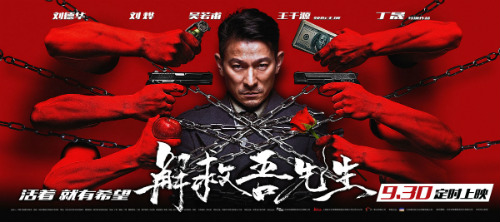 In 2004, actor Ruofu Wu was kidnapped and held for ransom in China. With his blessing (he has a prominent part in the film), director Ding Sheng adapted his story into film for Saving Mr. Wu. The cinematic version of the events follows Mr. Wu as he is kidnapped by Zhang Hua and three accomplices as he comes out of a karaoke bar. The kidnappers pretend to be cops to get him to cooperate but it becomes clear very quickly that they are taking him to pocket a ransom.
The actual police catch Zhang Hua while he’s gone to retrieve the ransom. As the police interrogate him, Mr. Wu attempts to use his skills to survive and help the other kidnapping victim survive as long as possible and not lose hope. Director Ding Sheng co-wrote the film with Alex Jia. Their script is an adaptation and fictionalization of the real kidnapping case most likely to make it more entertaining.
As with most adaptations if this kind, not all parties involved have the more exciting or exciting at all side of the story or even want to share it, so they add to fill in some gaps and spruce up some parts to make it more captivating. The characters are based on real people but also have been tweaked to make them all interesting.
The cast of Saving Mr. Wu is composed of the original Mr. Wu, Ruofu Wu, who here has the part of one of the men charged with saving Mr. Wu, cop Cao Gang. Wu does great work here and shows much interest in saving the movie version of himself. As the character of Mr. Wu, Andy Lau gives a layered performance of a man who is scared, worried, wants to fight, tries to help is co-kidnapped. His performance is one of the center pieces of the film, having the whole story revolve around him. Lau’s acting is superb here. The other very important performance is that of lead kidnapper Zhang Hua who spends a good part of the film gleefully being interrogated.
Qianyuan Wang plays this part to the fullest, not holding back and just going for it with the madness of the criminal he is representing. His presence on screen is captivating. His main interrogators are played by the aforementioned Ruofu Wu and Ye Liu as Xing Feng, an overworked father with a sick son he needs to get to. The film rests on the strength of its cast mainly as the majority of the scenes are a lot of dialogue including the scenes between Mr. Wu and his kidnappers, Mr. Wu and the other kidnapping victim, the interrogation of Zhang Hua, et al.
There are a few actions scenes but they are not the main focus of the film, however they are very well done nonetheless. The filmmakers gave these scenes plenty of attention, even hiring a car stunt coordinator, Bruce Law, who has close to 200 credits. The car sequences here are great and slightly reminiscent of the low-shot car scenes in Luc Besson written films. The other stunts are coordinated by Jun He and very well done as well. The camera does not shy away from the action and shows the cars, the hits, the whole thing without constantly cutting away or over-editing.
Saving Mr. Wu is a tense crime thriller with a true story background that keeps the viewer interested and connected to the story with good characters and great performances. The film is not build in a straight-forward manner, having its story skip forward and backwards in the timeline of the kidnapping which may require more attention but is absolutely worth it in the end.
Alone (Hongmin) (2015) [New York Asian Film Festival 2016]
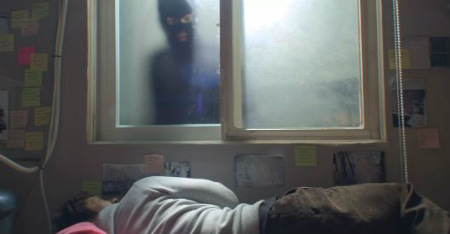 Sumin is a photographer documenting the gentrification and changes of his neighborhood. One day, as he’s taking more photos, he witnesses the murder of a woman. The killers come after him and he wakes up naked on what looks to be a gazebo in his neighborhood. Odd things happen; Sumin is rendered unconscious and wakes up in odd places over and over again. Alone, or Hongmin in its original language, was directed by Hong-min Park who co-wrote it with Hye-jin Cha.
The film is built in a way where the lead character of Sumin lives many events and those events may or may not be connected to each other. The story built with these does bring up questions but answers few of them. The film moves at a good pace, but with no established goal or point to it, it all feels a bit useless. Why is Sumin going through this? Is he alive? Is he dead and this is his purgatory? Was something lost in translation? The proceedings are somewhat interesting but not captivating which makes the film feel long even with its pace moving things along nicely.
The cast for this film is fairly small and everything revolves around Sumin who is played by Lee Ju-won. His performance is good with some nuances but with nothing really standing out which makes his presence a bit monotone through the film. However, it does feel like it may have been the point as his character seems to lead a bit of a humdrum life leasing to a less than exciting personality.
There is one scene with a major special effect and it’s quite good. However, to not spot it, details will not be discussed. The effect is, well, effective and well done. The sound accompanying it is a bit cringe-inducing, in a good way. A few other bloody bits are found here and there and they all look realistic as well, even when how they happen feels out of context for their scene.
As is the case with a lot of middle of the road films, neither great nor horrendous, Alone is hard to review without making it sound worse than it is. Alone is not a bad film and it has some good ideas, it’s just that the execution comes off as rather bland and that despite all of its efforts, it fails at really captivating the attention of its viewer. It may very well be a case of a film that is just not for everyone, so feel free to give it a try.

On the Beach (1959)
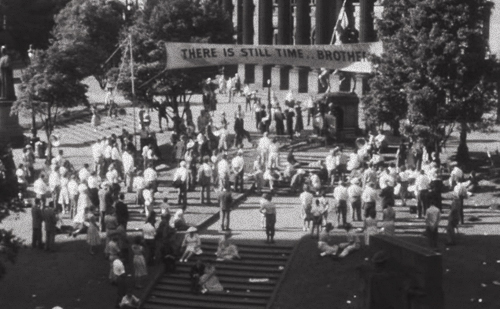 “On the Beach” is not so much about the end of the world, as it is about a large group of people who have to come to terms with the fact that they will die very soon. As most of the world has been destroyed by nuclear radiation, survivors have huddled in a small town in Australia far away from the fallout. But they soon learn it’s headed their way thanks to wind currents, and there’s no stopping it. We then view the requiem of mankind, as government officials continue to struggle to find a way to solve the problem, and then face that there’s simply no solution.
From there on, we follow a small group or characters that have managed to find a temporary safe haven from the radiation and rather than submit to panic and terror, they use their last days of sealing old scars, confronting old conflicts, and saying goodbye to the ones they love dear. Among a brilliant cast of performers like Gregory Peck, Ava Gardner, Fred Astaire, Anthony Perkins, Donna Anderson, and more, Kramer visits various ideas about life’s regrets and unfulfilled potential we never reach thanks to death.
Most tragic of the dilemmas involves Peter Holmes who has a beautiful newborn daughter, and knows that she won’t be able to see it through a year. He and his wife Mary are constantly embroiled in the lingering reminder of apparent death, while Mary is in pure denial and is certain all is not lost, especially when a crew journeys into the city in a submarine to answer the Morse code SOS from an apparent survivor. The most interesting element of “On the Beach” is the idea of the inevitability of death, and how one must accept it as a phase of life whether it approaches sooner or later.
“On the Beach” is one of the few thrillers that never attempts to sugar coat what is inescapable, and Stanley Kramer further induces that theme as he features desolate cityscapes of the highly radiated San Diego void of any human life or corpses, as well as droves of people lining up at hospitals to receive their cyanide pills. Even moments of happiness like fishing and romance are blanketed with sheer dread. Director Kramer’s drama is a bleak and heart wrenching tale of the end of the world, and a beautiful masterpiece about humanity’s last days for better and for worse.