
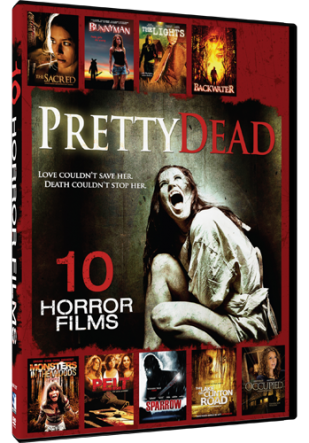
 Just in time for Halloween, Mill Creek Entertainment offers consumers a bargain with ten very notable indie horror films available in one pack. With just the right variety, “Pretty Dead” is hours of horror entertainment and interesting horror cinema that will make for a great weekend for any experimental horror buff. First up is 2011’s “Bunnyman,” the survival tale about a group of friends that run afoul a psychotic family of cannibalistic deviants that delight in torturing travelers. In order for them to make it back home alive, they have to evade the psychotic bunnyman, a deranged lunatic dressed as a giant rabbit. “The Lake on Clinton Road” from 2015 is a cabin in the woods thriller about a group of friends partying who begin disappearing in to the night. “The Lights” from 2008 stars Joe Estevez, and involves four friends who venture out in to the wilderness to catch a rare meteor shower.
Suggested Halloween Reading: 101 Movies To See…
 This Halloween from Apple Press comes Steven Jay Schneider’s ultimate compilations of “101 Movies to See” in paperback form and ready to own. For folks unfamiliar, Steven Jay Schneider is the man responsible for the 1001 Movies to See Before You Die, and he’s broken up the movies in to various genres and sub-genres of film. With a slew of contributors writing very insightful and interesting capsule reviews, Mr. Schneider edits every review breaking them up in to periods of film. Every book follows the particular points of the century from films from the 1900’s, and the 1910’s right down to the 2000’s, where the books typically end. At over four hundred pages, the “101 Movies to See…” work as small guide books that teach aspiring movies buffs where to start in particular genres, and whether or not you like or hate the specific titles the books recommend, you can at least be satisfied that you’ve seen an essential piece of cinema.
Night of the Living Deb (2016)
 Ever since “Shaun of the Dead,” many filmmakers have been intent on delivering their own horror comedies about self obsessed thirty somethings thrust in to the zombie apocalypse. Kyle Rankin’s “Night of the Living Deb” is not a masterpiece by any definition of the word, but it ends up being a decent diversion that has a good time using zombies as a means of emphasizing the dynamic between our main characters. Set on the fourth of July, awkward Deb awakens in the apartment of her love interest Ryan. Though she’s in love with him, Ryan isn’t entirely interested in her and is anxious to get her out of his life as soon as possible. Little do either of the pair know that overnight their small town of Maine has been consumed by a zombie apocalypse and everyone they known are now flesh eating zombies.
Five Ways to Fix “Fear the Walking Dead”
 I’ve given “Fear the Walking Dead” two seasons already and it’s failed to really impress me. It shifts locations constantly, doesn’t seem to garner one interesting character of the bunch, and there are so many sub-plots that are set up only to be left dangling at the end of the season. While most people are saying the show resolves a lot of the sub-plots, I still am asking a bunch of questions after the finale. Also, I’m still trying to figure out why the series builds up these huge storylines only for them to sputter out and run out of gas so suddenly? So Daniel really is dead or what? Why did Ofelia leave the hotel and go out on her own, again? Why didn’t she at least leave a note for Alicia? Was she trying to look for her father? So can Nick talk to walkers or was he hallucinating? Why did Madison and Alicia fight for the hotel and work so hard to clean it out as a refuge only for them to give it up at the drop of a hat?
The Conjuring 2 (2016) [Blu-Ray/Digital]
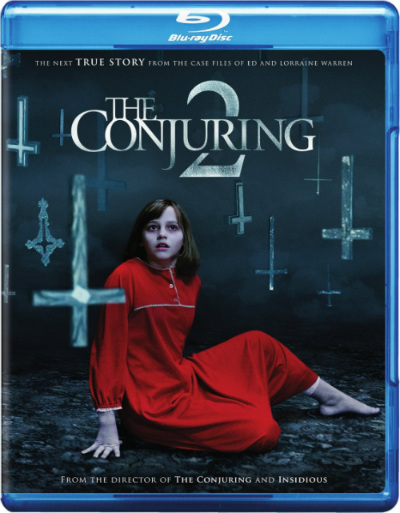 After the blundering misfire that was “Annabelle” I was a bit scared that “The Conjuring 2” would be a bland follow up to what was one of the best contemporary horror films ever made. Thankfully James Wan not only outdoes himself, but builds on the mythology of Ed and Lorraine Warren. “The Conjuring 2” follows the tradition of the original film, putting the Warrens in to an impossible situation where they have to do battle with a powerful evil. What’s more is that the evil has chosen to pick away at a vulnerable lower class family once again, prompting the Warrens to risk everything for the sake of one victim’s soul.
Lake Nowhere (2016)
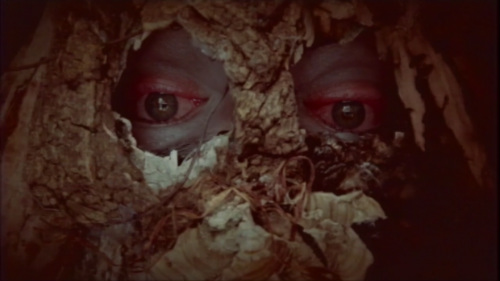 I don’t know if I’d called Maxim Van Scoy, and Christopher Phelps’s “Lake Nowhere” a masterpiece, but I have to say that the more it unfolded, I appreciated its enthusiasm more than anything. It wants to deliver a genuinely retro horror experience, and by god it succeeds most of the time. I’m not completely bowled over, though, as “Lake Nowhere” is really only fifty minutes in length. Five of those minutes are devoted to some faux horror movie trailers you’d find in front of a cheap horror VHS.
Videodrome (1983)
 David Cronenberg’s cinematic commentary on the power of media and how the media eventually controls you in ways you’re never quite cognizant of still rings true today. Even though “Videodrome” was more aimed toward the idea of television and our fascination with violence and human misery, Cronenberg’s thriller is still incredibly volatile in an age where humanity does nothing but stare at glowing screens zipping through a ton of data that eventually begin to depict how we live our lives. James Woods plays Max Renn, the owner of a porn television station who also has a penchant for sadism during sex. When he’s introduced to a television frequency called “Videodrome,” he begins to form a fascination with the footage of people being tortured, victimized, and raped.