
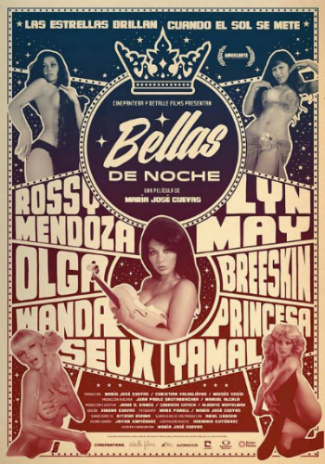
 This film documents the rise to stardom, fall, and aging of some of Mexico’s most famous showgirls. These women did it all, they sang, danced, acted, modeled, etc. They were revered by armies of fans and had it all. Lyn May, Olga Breeskin, Princesa Yamal, Rossy Mendoza, and Wanda Seux discuss their rise to fame, their lives, and their dreams.
Tag Archives: History
Sinful Cinema Series: The Abductors (Volume 1) [Paperback]
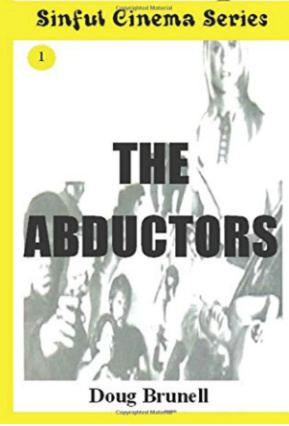 Combing the landscape of obscure cinema is tricky. It’s a journey that will often leave you with a lemon if you’re not careful. Author Doug Brunell’s reasoning for the “Sinful Cinema” book series makes a lot of sense as spotlighting certain movies that not many authors out there would be willing to spotlight is a neat idea. If you’re someone who wants to visit films that are completely out of the ordinary, author Doug Brunell seems intent on delivering spotlights for films you wouldn’t normally see discussed in most books about film. Sure, you can probably find summaries and brief essays about something like “The Abductors” in a review compilation, but author Brunell devotes an entire book to it. I’ve been a fan of Brunell’s since his days on Film Threat, so it’s fun to see him releasing a series of books for film lovers old and new.
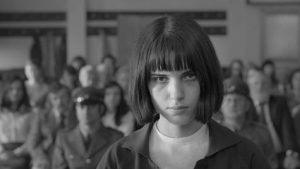
I, Olga Hepranova (2016) [Fantasia International Film Festival 2016]
 What pushes someone to once day decide they have had enough and that the only solution to be understood is to commit mass murder?
In 1973, in Prague (Czech Republic), 22 year old Olga Hepranova drove a truck into a waiting crowd, hitting 25 people and killing 8 of them. The film is the story of how Hepranova got to this massacre. Taking on the hard task of writing this story for the screen without falling into sensationalism or exploitation, writers Roman Cilek, Tomas Weinreb, and Petr Kazda, they took a delicate subject and turned it into a touching and beautiful story of a girl who feels as though she is being bullied and who has a long period of bad luck.
After long enough of asking for help and not receiving it, she decides to take drastic measures. They do not build Hepranova as a martyr or anti-hero but simply as a complex human being in need of help. Directors Petr Kasda and Tomas Weinreb took this script they co-wrote and turned it into a beautifully sad tale of a woman who possible could have been saved. The way they shot the film, in tandem with cinematographer Adam Kozakl in black and white and with very somber tomes is sublime. It takes this very heavy subject matter and make it bearable to watch. They craft a film that mesmerizes its audience while making them just a bit uncomfortable.
As so much of the film rests on her shoulders, the part of Olga Hepranova had to be cast perfectly. Actress Michalina Olszanska (mesmerizing in The Lure) was chosen and she is perfectly gloomy and fantastic. She clearly understood the depth and seriousness of the part, never over acting, always giving her all and stepping in Hepranova’s shoes, no matter how uncomfortable the process looks. She loses herself in the part and shows tremendous talent, proving that she is a start to keep watching. The rest of the cast is also very good to great with one stand, Klara Meliskova, as Olga’s cold, unloving mother.
She shows how one woman can be there and take care of basic needs for her child while showing absolutely no love or affection toward that child. Most characters are played as cruel or cold, except for the character of Miroslav, a man who tries to help Olga but has his own problems. This part is played by Martin Pechlat who brings a bit of light to the film by not being as serious as the rest of the cast. However, this is not in a funny or goofy way, but by showing just the right amount of light, even though highly flawed, to Olga’s life and the film.
The film is a must for fans of 70s Eastern Europe. The costumes by Aneta Grnakova and the art direction by Alexandr Kozak are perfectly on point. They give a great idea of what Prague and its people looked like in 1973. They do a very detailed job, bringing the era to life. I, Olga Hepranova is a somber film with a dark subject that is a part of Czech history. It was important that filmmakers behind the film pay attention to details and that they be careful to not over-dramatize the story. They do this while creating a perfectly gloomy film that should make any audience feel something.
The very timely subject matter of a mass murderer running people over with a truck is unfortunate but it should not keep people from seeing this film when the genre, style, or subject matter is something they would like to watch. This is not a film that is a feel good one; on the contrary, it’s depressing, sad, and beautiful.

Dongju: The Portrait of a Poet (2016) [New York Asian Film Festival 2016]
 In 1940s Korea, Japanese colonialists were banning Korea culture and the use of the Korean language in an effort to unify their territories and become a stronger world power. In this struggle, a young man named Yun Dongju starts writing poems in Korean while attempting to survive the assimilation of his people, reluctantly becoming a fighter in a battle to preserve Korea’s identity.
This historical film was written by Yeon-Shick Shin and directed by a new master of the genre, Joon-ik Lee. They create here a subtle and fairly easy to understand representation of what is considered a hard period in Korea through the eyes of a talented poet. The film takes its time showing the young life of Dongju as well as the societal shift that the Japanese colonizing brought. The poems read on black and white images of Korea are personal and real, they create a center for the story, an emotional anchor. These were carefully chosen amongst Dongju’s work to best suit the film and they bring a solemnity to the proceedings.
The casting for this film is pivotal as so much rests on how the lead of Dongju is interpreted. Kang Ha-Neul takes this character and develops him into a fully fleshed out human being, giving a voice for his soft yet emotional poems. He shows a wide range of emotions with subtle variations, giving life to this man whose story is mainly untold, especially to Western audiences. Supporting this performance are Jeong-min Park as Dongju’s cousin Song Monggyu who is someone who likes to stir the pot and possibly cause trouble for himself and those around him.
His performance is less subdued and a bit more in your face as time passes and the character requires the actor to be bolder. Also supporting Kang Ha-Neul is Moon Choi as Kumi, the girl who believes in him and does all she can to get him published, Her performance is also held back but stands out amongst the mostly male cast, showing a calm and strong female presence in a time when women were still encouraged to take a backseat to men’s dealings.
Shot in black and white, the look of the film is very serious which fits with the story and its developments. The way the Korean countryside is shot is absolutely beautiful, the images convey the seriousness of the situation the Koran people faced during that period. The pairing of filmed sequences with the reading of the poems is perfect. Unfortunately, a credit for cinematography could not be found online (in English or French) at the time this was written.
The black and white images and style in which the film is shot make sense for this film and its subject but they do make it feel slower and made it harder for this reviewer to concentrate on the story and the poems. The style is hypnotic but can also be sleep inducing if reading a lot of subtitles on a calm series of sequences is not one’s passion. The slowness here is deliberate to give the viewers time to absorb the emotions and pay attention to the poems.
Poet Yun Dongju led a tragic life, like most artists about whom movies are made, in the time period that was anything but easy. His story is worth watching for the quality of the film and the emotionality of his poems. Viewers will (should) also learn about a tumultuous time in Korea’s history, which can be considered a bonus. It’s a bit long and slow, but absolutely worth looking for and watching.
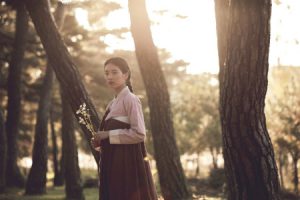
The Sound of a Flower (2015) [New York Asian Film Festival 2016]
 During the Joseon Dynasty in South Korea, Pansori opera was only sung by men as women were forbidden by law to sing. It was believed that a woman’s body was too weak to sing. Against those odds, Chae-Sun decides she wants to become a Pansori singer, going as far as dressing as a man to be allowed to sing. With much reticence, Pansori Master Shin Jae-hyo takes her under his tutelage and makes a great singer of her. When it’s found that the young man is in fact a woman, the master is imprisoned and the student makes a deal with the ruling Father-King Heung Seon Daewongun to save him.
The Sound of a Flower was written by almost a half a dozen people and still feels cohesive which means this is a great team and the director brought all of their work together with talent. Director Jong-pil Lee co-wrote the film with Ah-Young Kim, Jae-eun Jeong, Hye-rim Park, and Mi-na Chung. This team created a beautiful period piece and historical fiction where the history of Pansori opera and its first female singer is explored in a way that flows well and includes classic songs that most people outside of its country of origin have probably never heard. As the singing is very important in this film, the casting of a singer for the lead is not stunt casting as it often is but necessary.
In the part of Chae-Sun, the first female Pansori singer, is Bae Su-zy a member of the KPop group Miss A. Here she takes the part of Chae-Sun and disappears into it, becoming this other person, this sweet and timid, yet determined woman who takes on incredible odds to achieve a dream even the law forbade. From the get go, she gets the viewers to root for her and just keeps impressing them throughout the film, her subdued moments are contrasted by moment of pure courage and boldness and her performance shows great nuances and that she knows how to bring the right levels of emotions to each scene which makes her performance absolutely shine.
Playing opposite Bae Su-zy are Seung-ryong Ryu as the Pansori Master Shin Jae-hyo and Nam-gil Kim as Prince Daewon the King’s father. Shin Jae-hyo shows a calm determination for most of the film as well as a lot of care for Chae-Sun. His performance is subtle and strong, with emotions clearly held back most of the time, showing so much even in silent scenes. The man’s expressions talk for him many times, his eyes say so much. His emotions at times come through so well, they will break viewers’ hearts. Nam-gil Kim plays devilish with a passion, abandon even at times. His performance is less subtle and more extravagant with is entirely called for here with his more flamboyant character.
The attention to details in The Sound of a Flower is incredible. The costumes by Yoo-jin Kwon and Seung-hee Rim are beautiful and so well made. The production design by Jong-gun Lee looks stunning. These are showcased by cinematography by Hyun Seok Kim in scenes and sequences that linger on just the right things for just the right time. The balance in colors, brights, and darks is well thought out and gives room for the other visual aspects to shine. Of course, in a film about opera, the music is of high importance. Here the music by Tae Song Kim is subtle and adds perfectly to the classic Pansori songs and numbers.
The Sound of a Flower is a beautiful movie, well cast, well acted in stunning settings, with high quality costumes. Fans of historical dramas will love this musical and most viewers should learn a few things about Pansori opera. In all of this, it’s also a tragic love story based on historical facts that tugs at the heart.
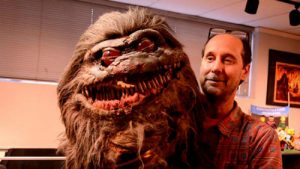
Creature Designers: The Frankenstein Complex (2016) [Fantasia International Film Festival 2016]
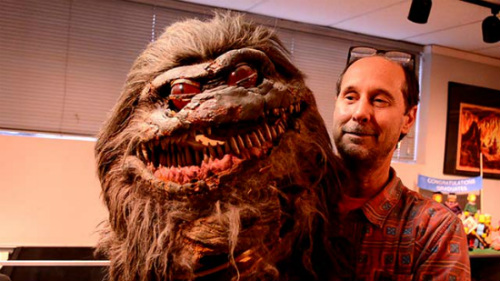 Film buffs will be elated to see “Creature Designers,” a very technical cogs and gears documentary that spotlights the grueling process of creating creatures for movies. Directors Gilles Penso, and Alexandre Poncet mold a love letter to the classic master creature creators, as well as a very down to business film that shows the technology behind some of the most iconic creatures and monsters of all time. It’s a thrill to see how the directors have such a reverence for these artists, as we get to visit with a ton of unique artists and concept designers that are enthusiastic about their work. Since the beginning of film, special effects and creature have found a wonderful marriage with filmmaking.
That’s thanks in part to Lon Chaney who was able to use his make up kit to build some amazing monsters out of his face and own features. From there it’s been a rising tide of artists and creators that have added to the cinematic experienced and helped advance storytelling as a whole. Both filmmakers visit with iconic masterminds like Rick Baker, Joe Dante, and Guillermo Del Toro, all of whom explore their love for special effects, and convey the process of building creatures for some of their films. What becomes apparent within “Creature Designers” is that the advancement of special effects would lead in to less and less necessity for suits and machines, and more need for computer technology.
This darker period is chronicled in “Creature Designers” where we’re able to view a more vulnerable side of these individuals, all of whom had to adapt to the shift in technology or risk losing their livelihoods. Thankfully, the documentary doesn’t depict the introduction of CGI and motion capture as the bane of the special effects industry. Directors Gilles Penso, and Alexandre Poncet explore some of the amazing advancements made in computer technology, from motion capture, facial recognition, and how they’ve used this kind of programming to bring to life amazing characters like Golum from “Lord of the Rings” and the T-1000 from “Terminator 2.” No stone is left unturned, as every interview is informative, exciting, and filled with amazing anecdotes.
For folks that are seeking a career in the special effects industry, or for films buffs very invested in the special effects element of filmmaking, “Creature Designers” is a wonderful documentary that brings us up close and personal from the fan viewpoint and a technical viewpoint.
Roots: The Complete Original Series [Blu-Ray]
 Alex Haley’s epic television miniseries is one of the many television epics I always meant to watch over the years, but never had the chance to. Finally being given the proper window by Warner, I was not surprised that “Roots” ended up being a very good epic drama about slavery, and the struggle for freedom. “Roots” is one of those great cinematic success stories, where in 1977, network ABC in America didn’t expect the mini-series to do very well. Due to its predominantly African American cast, and very strong content, the network pretty much dumped every episode over the course of eight nights, rather than spacing it out to create an audience.