post

Planet of the Apes (1968)

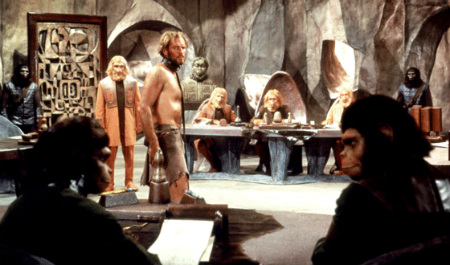
planetoftheapesIN LIMITED RE-RELEASE July 24th and 27th — It’s pretty exciting that two of the most important pieces of cinema ever released, “Night of the Living Dead” and “Planet of the Apes” would come in the same year and pack the same intellectual punch.  Written by non other than Rod Serling, “Planet of Apes” is like an extended episode of “The Twilight Zone” filled with terror, and social commentary. And much like the aforementioned George Romero horror film, “Planet of the Apes” garners an absolutely shocking ending that is still one of the best delivered finishers in film history. Though the title says it all, “Planet of the Apes” is still a rather unique genre experience, mainly for its willingness to avoid showing the apes until a good portion of the movie has passed.

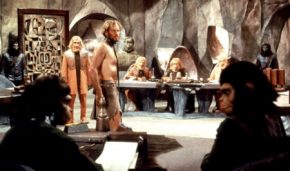
Charlton Heston gives an iconic turn as Colonel George Taylor, an astronaut who crash lands on a distant planet after a space expedition and learns the hard way that apes are rulers of this world. Primitive and yet completely organized in class systems that are identified through the species of apes, much like the human race, Taylor is stuck in a world he’s completely unfamiliar with, and can barely muster the strength to rebel, as the sights startle him. Pierre Boulle’s source material is drastically different from the film adaptation, but none of the impact is lost, nor is the commentary on the way we relegate our animals to the lower echelons of our society.

There’s the irony of our primitive counterparts becoming rulers of a jungle land while humans are servants, pets, and test subjects for medical experiments. Meanwhile the various ape species garner their own system of classes and aristocracies, mulling over the structures of their own society. The gorillas are police officers, military, hunters and workers, and the orangutans are administrators, politicians, lawyers and priests, while and chimpanzees are intellectuals and scientists. As Taylor watches his friends die, he inevitably begins to fight back, and, much to the shock of the apes, speaks back defiantly. This sparks an immediate rebellion, and prompts the ape society to completely re-think the way they operate.

“Planet of the Apes” features a world and society that’s different from ours and yet perfectly similar, even alluding that the apes are still in their early stages of evolution as a species. Franklin J. Schaffner’s production from the Serling script is masterful, with a massive cast of brilliant performers offering great performances. Heston’s turn is immortal, all the while folks like Kim Hunter, Roddy McDowall, Maurice Evans, respectfully transcend their ape visages to convey very unique and complex characters all around. “Planet of the Apes” is a pitch perfect science fiction film, that still conveys sharp social commentary and will win over the hearts of science fiction purists old and new.

Buy Tickets now at Fathom Events.

post

Day of the People (2016)

DayofthePeopleIt feels like there’s a little bit more gong on in “Day of the People” than a simple experimental short film. Based on the research I’ve done, director Philip Stainsby seems to have aimed for a short film reminiscent of “Night of the Comet,” but the visual cues seem to hint at something else entirely. “Day of the People” opens with a young man waking up at the very end of humanity and then begins traversing through the city and making his way through something of a business district where the sky is painted a dark shade of Red.

With only the discovery of a soda can, he walks through the streets looking for something, and finds it when he comes across a man walking around in a dark suit. Ultimately I interpreted “Day of the People” as something of a subtle commentary on the downfalls of a perfect Utopia and how some people are so committed to building a new world, they’re not likely to notice when something beyond their control is set to end their plans. Based on the small hints Stainsby adds, the people built this world and they also contributed to destroying it, thus making it a pretty open target for something else. Who knows?

Maybe I’m merely over thinking an experimental film, but Philip Stainsby’s short packs in a lot of nuance and complexity in only ten minutes time. The photography and direction are superb, with Stainsby committing to the dream like atmosphere and paints a grim look at what is the perfectly functioning society where all life isn’t quite present or even emotionally attached, for that matter. I gather “Day of the People” will leave many an audience debating about its meaning when it hits the festival circuit. Philip Stainsby’s short science fiction film is a remarkable short with unique and bold use of color and landscape. I hope to see more from him in the future.

post

Iron City Chronicles: Bitter Heart (2015)

BitterHeartNOW SEEKING FUNDING ON KICKSTARTER – It’s a real testament to Jason Turner’s talent that he’s able to pull off such a unique neo-noir with such a low budget. “Bitter Heart” is kind of a sequel to the original adventures of robotic private investigator Iron Joe. After being plagued with nightmares of a lost love, Joe is contacted by his ex-colleagues from Iron City’s police force when a young man is mysteriously assassinated. Linking evidence on the scene to a specific culprit, Iron Joe goes looking for the minds behind the murder and runs afoul a lot of interesting thugs willing to protect some secrets.

In particular, Iron Joe is on the track of a lead named Stoker, who is a CEO of Teknika, a corporation responsible for the robotic augmentations in the entire city. What link this assassination has with Stoker remains wholly ambiguous, but it’s intriguing to see how far Iron Joe is willing to go to take aim at corruption in the city. With some neat special effects both CGI and traditional, Turner unleashes this bold and unique wasteland where Iron Joe has somewhat bitten off more than he can chew with his assistant J.E.S.S. I hope we get to see how Iron Joe fares in the future, as “Bitter Heart” is a wicked prologue to an epic crime thriller.

post

Tickled (2016)

tickledmovIt’s almost like something out of a Creepypasta, a documentary filmmaker who comes across a fetish video of men tickling one an other for sport, learns there is a deeper and more sinister tale behind it. He then risks all to throw down the veil behind a seemingly large web of scandal and dark shadowy figures. Rest assured the unusual and eerie events that occur in Dave Farrier and Dylan Reeve’s “Tickled” are very real and unfold in a bizarre and eerie experience. Much like “Catfish,” this documentary feature explores one facet of a story and completely transforms in to something so much more enigmatic and mysterious.

And even potentially life threatening, once our filmmakers find themselves incapable of turning back from the hole they’ve begun digging in to a darker side of humanity and the internet. “Tickled” follows Dave Farrier as he stumbles upon a seemingly odd fetish video involving young men tickling one another strapped down on to tables. What Dave learns is that there is an actual sport called endurance tickling. Confused and slightly fascinated, Dave makes it a point of contacting the founders of the sport, only to learn that they greet him quite aggressively with homophobic slander and slurs.

Despite the initial correspondence confrontation, Dave continues digging in to the topic of Endurance tickling and falls out of favor with two conductors of the sport. After inviting them to New Zealand for interviews, they greet him with immense anger and aggression prompting a storm of legal threats, potential lawsuits and the promise of his career ending should he pursue the topic further. Shocked at how dark the initial search for a film subject has taken, Dave and Dylan challenge any threats at their professional career and begins to dig ever deeper and more thoroughly.

What’s so compelling about “Tickled” is not the world Dave Farrier uncovers, but the legal threats lobbied against him that most certainly can destroy his career and livelihood if he doesn’t walk on egg shells. The sad fact behind the documentary is the very absolute idea that the law is on the side of the folks that Farrier investigates, no matter how much deception and scandal he unearths. “Tickled” is a fascinating and entertaining documentary that spirals in to a rabbit hole of a shady subculture, online harassment, and the destruction of many lives all of which are met with the clicking of a mouse. There certainly won’t be another documentary like “Tickled” released in 2016.

Now in Theaters in Limited Release.

Slasher: Season One [Blu-Ray]

slashers1When last we saw Katie McGrath, she was suffering a cruel and unnecessary death in “Jurassic World,” and has now entered the sub-genre of the slasher film. A skosh more entertaining and engrossing than “Scream,” Chiller TV’s “Slasher” is a very entertaining, and tense slasher film that mixes in elements of a murder mystery in the process. I had no expectations for “Slasher,” and surely enough it won me over after two episodes, working within the confines of the slasher sub-genre, while also side stepping some of the more common clichés here and there. Much like “Scream,” main character Sarah comes from a small town where everyone has skeletons in their closets.

Continue reading →

post

Alone (Hongmin) (2015) [New York Asian Film Festival 2016]

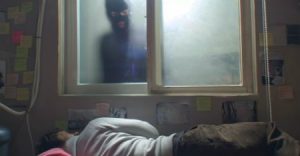
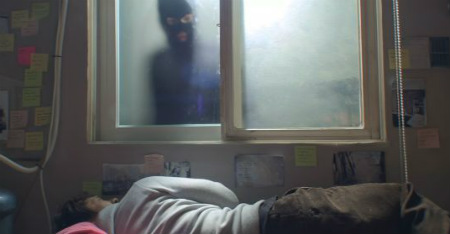
AloneHongminSumin is a photographer documenting the gentrification and changes of his neighborhood.  One day, as he’s taking more photos, he witnesses the murder of a woman.  The killers come after him and he wakes up naked on what looks to be a gazebo in his neighborhood.  Odd things happen; Sumin is rendered unconscious and wakes up in odd places over and over again. Alone, or Hongmin in its original language, was directed by Hong-min Park who co-wrote it with Hye-jin Cha.

The film is built in a way where the lead character of Sumin lives many events and those events may or may not be connected to each other.  The story built with these does bring up questions but answers few of them.  The film moves at a good pace, but with no established goal or point to it, it all feels a bit useless.  Why is Sumin going through this? Is he alive? Is he dead and this is his purgatory?  Was something lost in translation?  The proceedings are somewhat interesting but not captivating which makes the film feel long even with its pace moving things along nicely.

The cast for this film is fairly small and everything revolves around Sumin who is played by Lee Ju-won.  His performance is good with some nuances but with nothing really standing out which makes his presence a bit monotone through the film.  However, it does feel like it may have been the point as his character seems to lead a bit of a humdrum life leasing to a less than exciting personality.

There is one scene with a major special effect and it’s quite good.  However, to not spot it, details will not be discussed.  The effect is, well, effective and well done.  The sound accompanying it is a bit cringe-inducing, in a good way.  A few other bloody bits are found here and there and they all look realistic as well, even when how they happen feels out of context for their scene.

As is the case with a lot of middle of the road films, neither great nor horrendous, Alone is hard to review without making it sound worse than it is.  Alone is not a bad film and it has some good ideas, it’s just that the execution comes off as rather bland and that despite all of its efforts, it fails at really captivating the attention of its viewer.  It may very well be a case of a film that is just not for everyone, so feel free to give it a try.

post

On the Beach (1959)

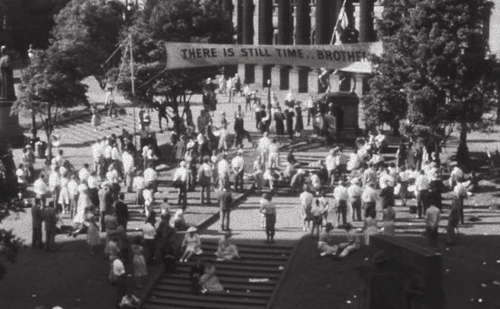
onthebeach“On the Beach” is not so much about the end of the world, as it is about a large group of people who have to come to terms with the fact that they will die very soon. As most of the world has been destroyed by nuclear radiation, survivors have huddled in a small town in Australia far away from the fallout. But they soon learn it’s headed their way thanks to wind currents, and there’s no stopping it. We then view the requiem of mankind, as government officials continue to struggle to find a way to solve the problem, and then face that there’s simply no solution.

From there on, we follow a small group or characters that have managed to find a temporary safe haven from the radiation and rather than submit to panic and terror, they use their last days of sealing old scars, confronting old conflicts, and saying goodbye to the ones they love dear. Among a brilliant cast of performers like Gregory Peck, Ava Gardner, Fred Astaire, Anthony Perkins, Donna Anderson, and more, Kramer visits various ideas about life’s regrets and unfulfilled potential we never reach thanks to death.

Most tragic of the dilemmas involves Peter Holmes who has a beautiful newborn daughter, and knows that she won’t be able to see it through a year. He and his wife Mary are constantly embroiled in the lingering reminder of apparent death, while Mary is in pure denial and is certain all is not lost, especially when a crew journeys into the city in a submarine to answer the Morse code SOS from an apparent survivor. The most interesting element of “On the Beach” is the idea of the inevitability of death, and how one must accept it as a phase of life whether it approaches sooner or later.

“On the Beach” is one of the few thrillers that never attempts to sugar coat what is inescapable, and Stanley Kramer further induces that theme as he features desolate cityscapes of the highly radiated San Diego void of any human life or corpses, as well as droves of people lining up at hospitals to receive their cyanide pills. Even moments of happiness like fishing and romance are blanketed with sheer dread. Director Kramer’s drama is a bleak and heart wrenching tale of the end of the world, and a beautiful masterpiece about humanity’s last days for better and for worse.