post

On the Beach (1959)

onthebeach“On the Beach” is not so much about the end of the world, as it is about a large group of people who have to come to terms with the fact that they will die very soon. As most of the world has been destroyed by nuclear radiation, survivors have huddled in a small town in Australia far away from the fallout. But they soon learn it’s headed their way thanks to wind currents, and there’s no stopping it. We then view the requiem of mankind, as government officials continue to struggle to find a way to solve the problem, and then face that there’s simply no solution.

From there on, we follow a small group or characters that have managed to find a temporary safe haven from the radiation and rather than submit to panic and terror, they use their last days of sealing old scars, confronting old conflicts, and saying goodbye to the ones they love dear. Among a brilliant cast of performers like Gregory Peck, Ava Gardner, Fred Astaire, Anthony Perkins, Donna Anderson, and more, Kramer visits various ideas about life’s regrets and unfulfilled potential we never reach thanks to death.

Most tragic of the dilemmas involves Peter Holmes who has a beautiful newborn daughter, and knows that she won’t be able to see it through a year. He and his wife Mary are constantly embroiled in the lingering reminder of apparent death, while Mary is in pure denial and is certain all is not lost, especially when a crew journeys into the city in a submarine to answer the Morse code SOS from an apparent survivor. The most interesting element of “On the Beach” is the idea of the inevitability of death, and how one must accept it as a phase of life whether it approaches sooner or later.

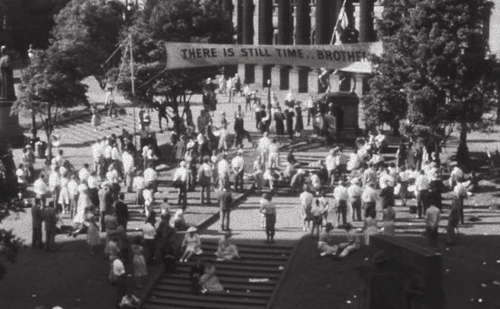
“On the Beach” is one of the few thrillers that never attempts to sugar coat what is inescapable, and Stanley Kramer further induces that theme as he features desolate cityscapes of the highly radiated San Diego void of any human life or corpses, as well as droves of people lining up at hospitals to receive their cyanide pills. Even moments of happiness like fishing and romance are blanketed with sheer dread. Director Kramer’s drama is a bleak and heart wrenching tale of the end of the world, and a beautiful masterpiece about humanity’s last days for better and for worse.

Batman v Superman: Extended Cut or Why You Can’t Pour Perfume on a Pig

batmanvsuperman1Pearls. Again. Bruce Wayne’s origin. Again. Joe Chill. I’m presuming. Again. I can still hear the echoes of fan boys rejoicing that “Batman v Superman” wouldn’t be another origin story, and yet director Zack Snyder allows us the thirtieth origin of Bruce Wayne, all for the purpose of squeezing in Bruce muttering “Martha.” Which is his mother. And so a thousand memes were born.

Director Zack Snyder doesn’t allow us the benefit of young Superman or Clark Kent with his mother, also curiously named Martha, because that would make sense. Plus, Snyder never worked with Diane Lane or Kevin Costner. It would be funny though to see Jeffrey Dean Morgan and Lauren Cohan playing John and Martha Kent.

Continue reading →

post

Dèdalo (2016)

dedaloI hope director Jerónimo Rocha eventually turns his idea for “Dèdalo” in to a feature length horror film. While I love “Dèdalo” all on its own, I’d love to learn more about the specifics behind this narrative, and how these monsters spawned. The monsters presented in this nightmarish feature seem almost bred out of oil and muck, and they seem to infect those around them with this crude substance that makes their victims deformed prey. “Dèdalo” begins on a very strong note as we witness young Siena climbing along the side of a Space Freighter/Refinery.

Wounded and very torn after what seems like a hellish fight for survival, she seeks out a medical kit lying alongside the body of one of her shipmates. While one of the disgusting beasts on the ship feasts on a lost comrade, she looks to inject herself with some kind of antidote that can perhaps cure her of what seems to be an infection that’s made right hand black as coal. But the situation become more difficult as she tries to cure herself without being heard, and out wit the creature only inches away from her.

“Dèdalo” has a marvelous atmosphere and sense of mood behind it, making it feel like a nightmare. It definitely draws its inspiration from “Alien” even borrowing the strobe light effect that gives director Rocha’s short an added layer of menace and terror. “Dèdalo” is a wonderful short horror film that uses its apparent influences to enhance its narrative and concept; I’d love to see director Jerónimo Rocha use this as material for a feature length production. I think “Dèdalo” could become a classic.

post

Return of the Killer Tomatoes (1988): Special Edition [Blu-Ray]

ROTKTGood God, it’s usually around the fifth movie in a horror series where the writers start poking fun at themselves, not the first sequel. John Astin is a mad professor named Gangreen who is secretly engineering tomatoes to be able to transform in to humans set to various genres of music, and plans to unleash another invasion on the world. Ten years after the events of “Attack of the Killer Tomatoes,” tomatoes are outlawed and anyone that is found with them is arrested. So naturally the big joke centerpiece of the film is that we follow a young pizza delivery man named Chad who helps operate a pizza place that uses every ingredient except tomato sauce.

Chad, who constantly makes deliveries to Gangreen’s mansion, is in love with his assistant Tara, who happens to be a tomato. When Tara escapes Gangreen’s clutches due to him attempting to kill a fuzzy tomato mutant, Tara seeks Chad’s help. Meanwhile Gangreen goes looking for her with his muscle bound killer tomato commandoes. “Return of the Killer Tomatoes” is one of the very few meta-science fiction comedy spoofs that sometimes don’t even seem to try to tell a story. It’s a movie so tight on budget that there are never actually any rampaging killer tomatoes here. This is more a romantic comedy with a Frankenstein twist involving a killer tomato that can turn in to a hot woman, who begins falling in love with a normal pizza delivery man.

It’s almost like tuning in to watch “Friday the 13th” and only see people talk about Jason Voorhees, and never actually seeing him on screen at any point. “Return of the Killer Tomatoes” spends a lot of time spoofing its own premise that it never actually takes the time out to unfold a narrative. That doesn’t make the film terrible, but it does hinder any efforts director John De Bello has to aspire toward the comedic lengths of “Airplane!” Characters break the fourth wall, co-star George Clooney breaks character, and there’s even a gag involving product placement. It comes out of nowhere and is blatantly tacked on, but it is quite a funny segue, all things considered.

Every cast member works in different wave lengths in the film, with Starke playing his character as goofy as possible, while Clooney is mostly a straight man who tries tongue in cheek comedy every now and then. Astin is nearly loses teeth chewing the scenery, and his comically uneven turn is quite the attraction. “Return of the Killer Tomatoes” could very easily have been an awful film, but its sheer relentless absurdity and embracing of its low budget compensates for the fact that there aren’t really any killer tomatoes in the film.

Along with a reversible slip cover, there’s also a new interview with star Anthony Starke, who discusses his experiences working with George Clooney. True to form, Clooney was a prankster on set, and the pair had a good time partying. There’s a two minute still gallery, the original theatrical trailer, and a thirty second TV Spot. Finally, there’s a brand new audio commentary with writer and director John De Bello who, with host Michael Felsher, discusses his history with the movie series, and how he went about making the film on such a miniscule budget. This is an informative commentary with some fun anecdotes.

post

Sonic the Hedgehog: The Movie (OAV) (1999)

sonic-movie1999Shut up, Tails! Granted, I have always liked the “Sonic” movie from 1999 that finds him battling Metal Sonic, but Tails has to be the most grating animated sidekick of all time. True, he’s still a useful superhero, but in the end I hated this character. “Sonic The Hedgehog: The Movie” from 1999, originally made in 1996, is the anime continuation of the original animated series from the mid nineties. I speak of the very good animated adventure, not the crappy Looney Tunes knock off that aired almost at the same time. This time around Sonic is relaxing in his world alongside Tails, and finds out that Robotnik aka Eggman is back.

He’s kidnapped the president and his daughter, insisting Sonic and Tails must go to Eggmanland to stop his evil clone. Dark Robotnik is a robotic beast with massive wings who thinks like Robotnik, and Sonic has to travel to the city to stop the generator before it explodes. But things get tough as Sonic and Tails realize the city has a ton of hazards, and they’re hopelessly outnumbered. Plus, they don’t know that Robotnik has Hyper Metal Sonic, a robotic version of Sonic, waiting for him ready to be activated. Thankfully though, Sonic and Tails aren’t completely alone, as they gain the help of their rogue friend Knuckles.

Knuckles, once an anti-hero, is now an adventurous hero who takes it upon himself to make sure Sonic and Tails pull off their mission safely. “Sonic” is a short and sweet animated adventure with some darn good animation, and an excellent cyberpunk aesthetic that anime buffs and followers of the cyberpunk sub-genre will appreciate. Though, admittedly, the movie is slim on narrative, the director makes up for it with some killer action, and picturing Sonic, Tails, and Knuckles doing what they do best, and looking darn cool performing their signature moves we’ve seen in the classic games. This is a movie that still holds up; it was a lot of fun back in 1999, and it’s a good time today.

post

Midnight Special (2016) [Blu-Ray]

midnightspecialblu“There’s a star man waiting in the sky, he’d like to come and meet us, but he thinks he’d blow our minds…”

Jeff Nichols’ science fiction thriller owes a lot to John Carpenter’s “Starman,” mainly because he aspires to achieve the same exploration of humanity with his own film that also speaks very heavily about our own society. Right down the truly excellent score by David Wingo, “Midnight Special” feels like new wave John Carpenter, as it’s an ode to the classic seventies and eighties science fiction films that teams family against impossible odds. This time, it’s a young boy named Alton who is imbued with amazing and enigmatic powers that has made him something of a martyr for a religious cult.

Born under mysterious circumstances, Alton became the figure of worship for a relentless cult, and is perceived as an omen of a higher power making its way to Earth. His dad Roy and best friend Lucas break him out and seek to re-unite him with his mother, all the while trying to figure out why Alton is on Earth and what his ultimate purpose is. Like “Starman” and “E.T.” Roy, Lucas, and Alton find themselves evading the government and local law enforcement, all the while trying to also side step their temptations to return to the comfort of their cult. With two of their members on the hunt for Alton to bring him back to their clutches, the quest to help Alton becomes more harrowing and deadlier by the hour.

“Midnight Special” is a beautiful ode to the science fiction of yesteryear that also obtains its own substance and complex ideas about our own world and reality. Michael Shannon and Joel Edgerton are rather superb as two men with their own goals to save Alton who aren’t always on the same page. Shannon as father Roy will do anything to save Alton, even if it means gunning down a highway ranger, while Edgerton as Paul is very strategic and much more rational. Alton is a very unusual and mysterious being who begins drawing just about everything to him, and becomes this walking magnet metaphorically and literally.

The idea of what Alton could represent becomes gradually more intriguing the more Roy and Paul fight to get him to safety. Once Kirsten Dunst is introduced as Alton’s mother and ex-cult member, there’s much more comprehension on what his presence means. Once Nichols has the opportunity to explain Alton to the audience, much of what “Midnight Special” is comes full circle to represent something so much more complex and insightful. Nichols doesn’t opt wholly for a cinematic tribute, as he also realizes that there’s some interpretation to be gained. “Midnight Special” is a surprisingly transcendent science fiction tale about humanity and our state of being. Jeff Nichols’ drama is a bonafide gem, and one that deserves to be appreciated and studied.

The Blu-Ray release for “Midnight Special” comes with a five minute segment called “Origins” about the inspiration for the film, and the central themes, along with interviews from the cast. Finally, there’s the twelve minute multi-chapter “The Unseen World” which focuses on the multiple characters and their arcs, including Roy, Lucas, mom Sarah, Alton, and NSA agent Sevier, as played by Adam Driver.


post

Steel (1997)

Steel1997

If you ever sat down and wondered “Why did it take so long for an Iron Man movie to hit theaters?” then you’d be wise to sit down and watch “Steel.” Not only did studios not invest in loyal adaptations of superheroes in the nineties, but the concept of a man in a metal suit fighting crime was impossible to put on screen. Especially if you have a studio unwilling to invest in committing to the concept and making it feel somewhat realistic with CGI. Steel was originally birthed as a Superman clone with a concept very similar to Iron Man. John Henry Irons was a weapons developer betrayed by his organization.

When Superman died, he took his weapons of mass destruction and used them to build a steel suit to help keep law and order in Metropolis. When Superman came back from the dead to take back his mantle, Steel became his own superhero with dignity and some sense of stature, but was always something of a fourth rate Iron Man clone. Obviously Warner took the concept and premise for this somewhat notable superhero and turned it in to a clunky and campy superhero adventure with zero stakes. Suddenly everything Jon Bogdanove, and Louise Simonson worked toward in making “Steel” somewhat of a hero in his own right was undone by this ridiculous movie. Here, there are only three vague references to Superman, while Shaquille plays an unconvincing military officer who is also developing weapons for combat. Judd

Nelson plays villain Nathaniel Burke whose lust for violence destroys their experiment causing John Henry Irons to be discharged from the military while Annabeth Gish as friend Sparky, is rendered a paraplegic. When John returns home, he learns his weapons are being streamlined for gang combat, and Nathaniel is behind it, making a deal with an arcade game exec to distribute and sell his high tech weapons. And he’s really evil, because they’re recruiting teenagers to test their weapons, booga, booga! “Steel” is a marvel of superhero cinema, mainly because it’s so painful watching Shaquille O’Neal stomping around in a heavy steel suit that looks so ill fitted to his form it gets gradually more embarrassing as the film unfolds. Why even bothering to adapt Steel is mind boggling, but adapting him in to this kids film makes the investment so much more horrendous.

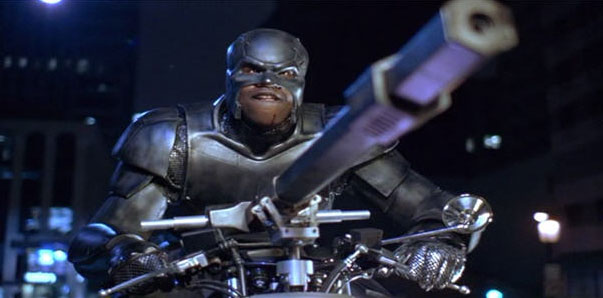
The initial revelation of Shaq’s character John as Steel is supposed to be awe inspiring and cool, but Shaq looks so goofy in costume. It’s bad enough the suit looks heavy and clunky, Shaq can barely run around in it, but the helmet he wears makes him look awfully cross eyed. I’m willing to suspend my disbelief at a man running around in a clunky metal costume, but the police in the movie are so inept, they can barely keep up with the man moving as slow as molasses. Plus, it wouldn’t be too hard to find Steel’s alter ego. Just look for the only man in the city who is seven feet tall. From there, “Steel” is reliant on a heavy formula of repetition and camp that’s more obnoxious than cute.

To make the cruel experience more endurable here’s a good drinking game for you: Take two shots every time Shaq makes a basketball reference. Take a shot every time Shaq mumbles through a line. Take a shot every time Shaq rips something apart or breaks someone’s property. Take two shots every time Judd Nelson flares his nostrils. Your liver will be shot by the time the movie comes to a merciful close. Thankfully, “Steel” didn’t complete destroy the comic book movie, as it took “Blade” only a year later to prove comic book movies could be a bankable property worthy of an audience and franchise. The media usually credits “X-Men” but really, it started with “Blade.”